Ending Up
... reflections as the world moves on

[This is the final extract from Through Mud and Barbed Wire, an account of the impact of the First World War on two great thinkers - Paul Tillich (German; serving as a chaplain and grave-digger) and Pierre Teilhard de Chardin (French; serving as a stretcher bearer).]
Death is never quite the end of a story. We cannot leave Teilhard felled by his heart attack, at the window, looking out over New York, or Tillich in hospital a decade later. Their story has and deserves a sequel, if only because they continue to challenge Philosophy and Theology in the 21st century.
New Harmony
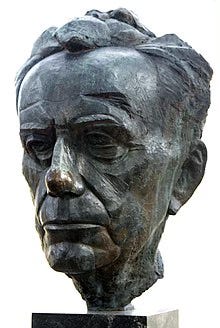
The bust of Tillich at New Harmony
A century before Tillich volunteered for military service, a group of German Lutherans from Pennsylvania set out to build a new town in the wilderness on the banks of the Wabash River in Indiana. They named it Harmony, and established a thriving and hard-working community, although accounts suggest that they mostly lived a very simple, austere life under the strict guidance of their founder, George Rapp. A decade later, Rapp decided to move back to Pennsylvania and sold the whole town to the wealthy social reformer Robert Owen, who intended to set it up as a utopian community and renamed it New Harmony. His idea was that it should be a place of happiness and prosperity, based on communal living and education. The community was not an economic success, but it made significant contributions socially – setting up a public school system for both girls and boys, along with a free library and a drama club.
Owen’s dream, like that of the hard-working community of German Lutherans, did not last, but the town of New Harmony remains, with many of its original houses now restored and boasting a long history of intellectual life in both arts and sciences. Here, in 1963, a park was dedicated to Paul Tillich, complete with a bust (by James Rosati) and stones engraved with quotations from his work. Although initially his ashes had been buried in East Hampton, the family decided that it would be more appropriate if they were moved to New Harmony, so they were re-interred in the park on 29th May 1966. It seems an appropriate resting place, in a town dedicated, as was Tillich, to the dream of a better society, to a blending of disciplines and to a commitment to serious academic work. A town set up by industrious German Lutherans, welcoming into its midst a man who – for all his enjoyment of life in America – was above all an industrious German Lutheran at heart.
He had taken the lead in promoting liberal theology, both in his lectures and his writings. His Systematic Theology has been profoundly influential in the world of Protestant theology and the depth of his scholarship admired, even if his ‘system’ has been criticised by some. His theological legacy is immense, sustained by the Tillich Archives at Harvard and at Marburg, the volumes of his collected works of philosophy, published in German in 1989, and the activities of, among others, the North American Paul Tillich Society, and its German-speaking counterpart, the Deutsche Paul-Tillich-Gesellschaft.
Beyond the world of academic theology, a major thrust of his contribution to both religious and secular thought was his ability to pull together insights from different disciplines through the breadth of his cultural references. His insights and his language – as we have already seen – fed into popular explorations of religious belief in a modern context. Presented from a perspective nourished by decades of serious research and extensive reading, he gave depth to religious ideas, showing them to be rooted in universal human insights and intuitions. He managed to hold together a sense of what is most real, with what people need by way of direction and commitment if their lives are to be experienced as meaningful.
Paris in 1981
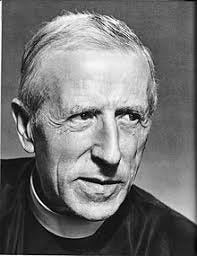
And Teilhard? After his death in New York, the frozen earth finally yielded to receive his body, but that was not really his ending. During his lifetime, his reputation was built upon his work in geology and palaeontology, but through the late 1950s and 1960s enthusiasm for his philosophy and religious writings and a constant stream of publications, both of his work and about it, meant that his non-scientific writings, which in his lifetime had been shared only among his trusted friends, became known to a wider readership. A global network sprang up, promoting his ideas, both within the Catholic Church and within a secular world that had started to ask radical questions, both about religion and about the future of humanity. The ‘Fondation Teilhard de Chardin’ was established in Paris in 1962, and ‘The Teilhard Centre for the Future of Man’ in London in 1966.
His mystical writings, along with The Phenomenon of Man, were to influence the Catholic Church, then in the midst of the reforming movement of the Second Vatican Council, which had been announced by Pope John XXIII in 1959 and ran from 1962-5. Around the world, a network of Teilhard Groups and Centres started to run programmes celebrating and developing an appreciation of his work, recognising him as an important thinker and visionary prophet of the future convergence of humanity and its implications for social and political thinking. Within a decade of his death, the solitary religious philosopher, whose community of peers was scientific rather than theological, had become a global phenomenon, his ideas shared in a way that was entirely appropriate for one who had noted the phenomenon and ethical significance of a global vision and a convergent evolution.
Although his philosophical and religious writings had not been approved for publication during his lifetime, a quarter of a century later he received something of a rehabilitation. Cardinal Casaroli, Secretary of State, writing on behalf of Pope John Paul II, whilst acknowledging the difficulties with his work and the need for critical and serene study, admits Teilhard’s ‘bold attempt at a synthesis, the witness of the unified life of a man seized by Christ in the depths of his being, and concerned to honour faith and reason at the same time.’ This was in stark contrast to the warning of Teilhard’s ‘ambiguities’ and ‘grave errors’, issued by Holy Office on its own authority in 1962 in circumstances that Pope John XXIII was later to describe as ‘most regrettable.’ Even the General of the Jesuit order was able to speak of Teilhard’s drive ‘to bring out the place of Christ in the evolutionary world which modern science compels us to recognise’ and acknowledged Teilhard’s faith and the weight of suffering that he had borne.
His real homecoming, not physical but spiritual, took place in 1981, the centenary of his birth, when his life and work was celebrated back in his native France. In life he had been denied his wish to stay in Paris and take up a post at the College de France. Now, 26 years after his death, his life was commemorated by a Mass in the Cathedral of Notre Dame, with a homily given by Archbishop Jean-Marie Lustiger, and at UNESCO a commemorative ceremony was addressed by President Mitterrand. With an exhibition at the Natural History Museum in Paris, and meetings at the Catholic Institute in Paris and UNESCO, his work was at last being freely discussed and appreciated in his natural home.
For a man with such a deep love of France and its culture, it was appropriate that his position should be given a concrete and localised expression. By municipal decree in September 1981, a square in the 4th arrondissement of Paris, just a few minutes walk from the north bank of the Seine was named ‘Place du Père Teilhard de Chardin’ and a street on the rive gauche, a short walk from the Sorbonne and the College de France, became ‘Rue du Père Teilhard de Chardin’.
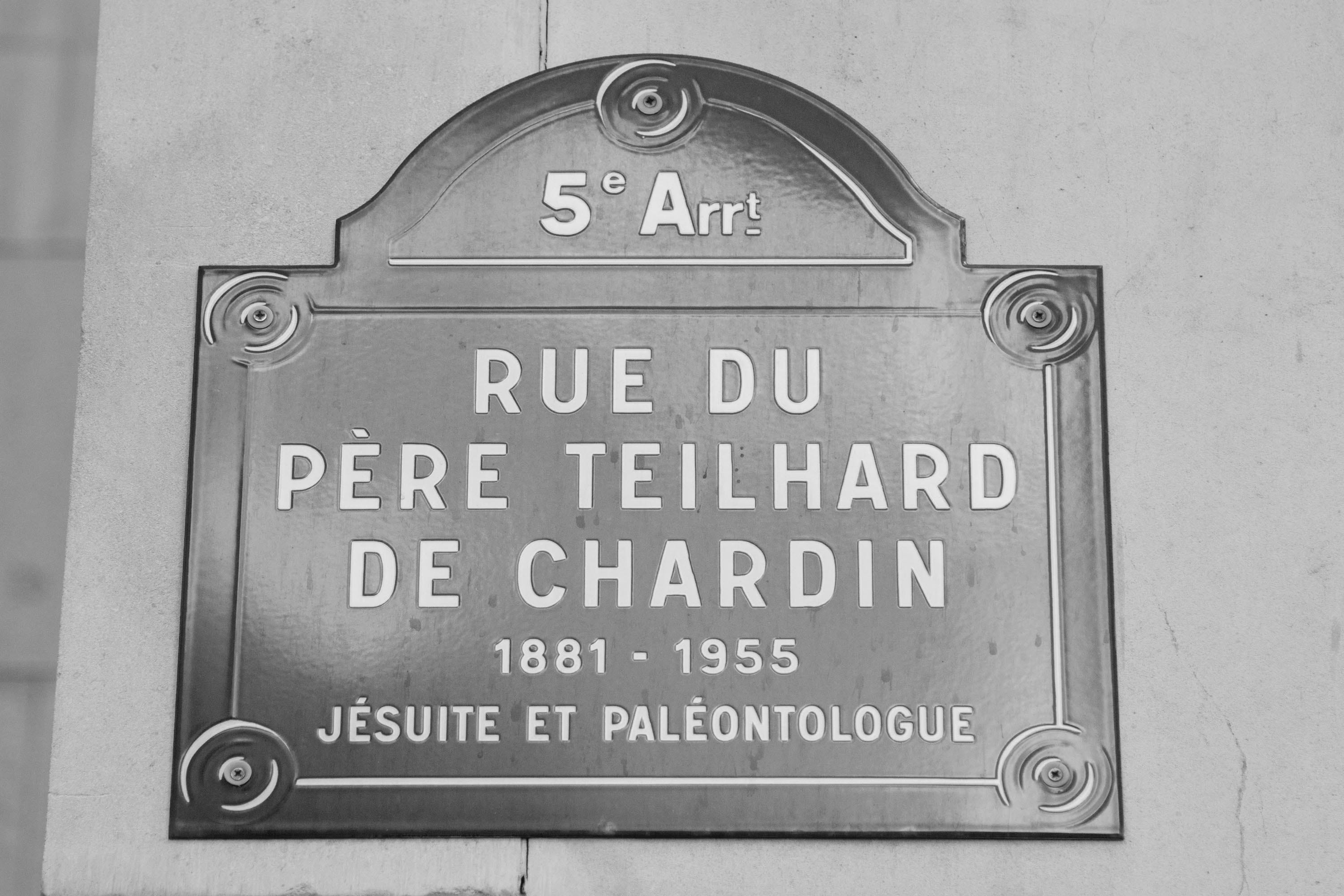
It spread beyond Paris. The Catholic University of Lille has a hall of residence named after him. La Chapelle-Saint-Luc has him as the name of a bus and coach station, located at the end of Rue Teilhard de Chardin, a name shared by streets in Metz, Ris-Orangis, Villefranche-sur-Saone and Bellegarde-sur-Valserine.
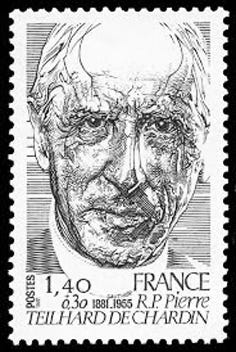
When at the Front in 1916, Teilhard had been a regular correspondent, with his cousin, his parents and others, and it is through his letters as well as his journal that we can start to appreciate him as an individual thinker as well as a deeply spiritual and troubled man. It is perhaps fitting therefore that the most widely dispersed of all the public events marking his centenary in 1981 should be the issue in France of a commemorative postage stamp. Goodness knows what he would have made of that – apart from a certain pride as a Frenchman in having his head and name on a stamp of his native land from which he had felt himself to be exiled for so much of his life.
Moving on…
It has been over 60 years since Teilhard died, 50 since Tillich. They were giants in the theological world; troubled, full of anxiety, reflecting the hopes and fears of their times and the traumas of the first half of the 20th century.
Their story leaves us questions about what we do with their insights and their hopes. Between then, Tillich and Teilhard – provoked into original thought by the horrors of Verdun, but splendidly equipped for that task by their backgrounds – started to put together an agenda for the future of God from which, by and large, the world has shrunk. Can we find a direction and a sense of purpose, a future for humanity that is both global and personal, to which we can commit ourselves? How can we speak of and celebrate the depth and meaning of life? These are the questions they asked, at great cost to themselves, in that first half of the 20th century; those questions remain with us, and their answers remain relevant.
Both Tillich and Teilhard displayed remarkable intellectual gifts, but in utterly different ways. Tillich brought a huge body of knowledge and a fierce intellect to the question of the meaning of life and the fundamental questions addressed within the Christian tradition. He drew upon sociology, psychology, history, cultural studies, philosophy, the old pietist and the Lutheran traditions, holding together rationality and experience in a way that makes him a 20th century extension of the Enlightenment. By contrast, Teilhard – although well versed in Catholic theology – contributed very differently. He was a natural mystic, with a profound love of all things physical. He loved science and was passionate in exploring human origins. Yet his eyes were also on the future, seeking to give humanity a single, spiritual and personal focus. And this, of course, he identified with Christ at Omega; by spiritual conviction and loyalty to his tradition he could do no other. He gave voice to a determination not to allow religion to be sidelined into a narrow ‘club’ for the holy, separated from the mainstream of human endeavour. He was convinced that, to fulfil himself as a Christian was also to fulfil himself as a man. There is no separation of secular and sacred in Teilhard – they flow together as people look to the future; their hopes embrace both.
It is a feature of the best philosophy and theology that, beyond critical analysis or dogma, it encourages us to think about the values and goals to which we commit ourselves. Its importance is illustrated by the courage of those who act, with their eyes open, in a world where the future always appears uncertain but the past, with hindsight, sadly inevitable.
Counterfactuals and a personal coda…
What if the shells had fallen differently? A small adjustment to the trajectory of two rounds would have been enough to ensure that Tillich and Teilhard, if not found whole, identified and buried, would be visible now through the windows of the Ossuary at Verdun or on one of the other battlefields.
What if Teilhard had not chosen to read Balzac or Bergson in those crucial months when his thoughts were being focused on making sense of the war? What, indeed, if he had been appointed chaplain rather than stretcher-bearer and therefore, like Tillich, been expected to offer theological interpretation on a daily basis? I sense that, for all his devout nature, Teilhard actually rather enjoyed the secular life of the troops, as later within the scientific community. It provided the context for a more radical development of ideas than would probably have been the case had he been confined to religious duties.
What if the Jesuit Order had not muzzled him? Would his thought have received earlier scrutiny, such that he might have had more of an opportunity to develop it in open debate? What if, in response to his harsh treatment by the Order, he had finally given up the priesthood? What if he had been laicised and settled down with Lucile Swan? Could his work have been shaped as it was other than in the harsh reality of his ‘double love?’
What if Tillich had secured an academic post early enough, or had opted for a honeymoon rather than volunteering for war service when he did? He was later to be jealous of those already established in their careers. What if that had been him? Would he, without the trauma of war, have found the courage to set aside the old traditional God of his father and upbringing?
What if he had not gone to Marburg, encountered the work of Bultmann and Heidegger, or made friends with Otto? What if he had compromised his views and kept his academic post when challenged by the Nazis? What if he had never gone to America with the freedom it offered him to write and teach?
And as for myself; had I not picked up those copies of Honest to God and The Phenomenon of Man in my formative teenage years, I might well have become either an architect or a medic, which were the careers I was considering before being beguiled by that stretcher-bearer and chaplain into the study of theology and philosophy. Our life is always haunted by its counterfactuals.
Both Teilhard and Tillich wrestled with fundamental questions, and suffered personally from their commitment to do so. I hope their story, from the trenches of the Great War to their exile in New York, encourages us to continue to keep open the same questions in the very different circumstances of the 21st century. Personally, I have found that the study of their work, over a span of almost fifty years, has involved a great deal of angst, beset as I too often am by self-doubt and fear of rejection. Many years ago, faced with opposition to my theological views, I opted out of the Christian tradition and, two decades later, out of a branch of Buddhism, in both cases lacking the courage to do battle. I have remained on the boundary, frustrated with the superficiality of much secular philosophy and convinced that, to be a thoroughgoing rationalist is to be emotionally disembowelled. On the other hand, through music, art, dance, drama, meditation, hiking, immersion in landscapes and the bidding of the moral sense, we touch the richness of that reality to which I can give no name – for every name (and especially ‘God’) is inherently limited and fails to do justice to what is experienced.
Arguments today about the existence, or non-existence, of God generally take place in the context of secular atheism. And yet, from the overtly crude to the philosophically sophisticated, most of those arguments relate to an idea of ‘God’ to which neither Teilhard nor Tillich could possibly have subscribed. For all the dated nature of some of their arguments, they at least keep open a fundamental human question: How do I find direction, meaning and purpose in life? How do I hold on to values that I judge to be ultimate? How do I celebrate all that is good, and contribute towards building something positive for the future?
Asked whether I believe in God, I generally answer “of course not”, seeking to avoid misunderstanding. Whatever the reality of ‘God’ might be, it is something to be known, explored and lived; not something ‘out there’ in any sense whose existence might be discussed, believed in or doubted. And yes – that is exactly the point that Tillich made in saying ‘God is not a being, he is being-itself.’ So I stand, for now at least, on the ever-shifting and transient ground of secular, religious atheism. But I like to think that, even if Teilhard might have shaken his head in despair, at least Tillich would have understood.
The silence of the hills
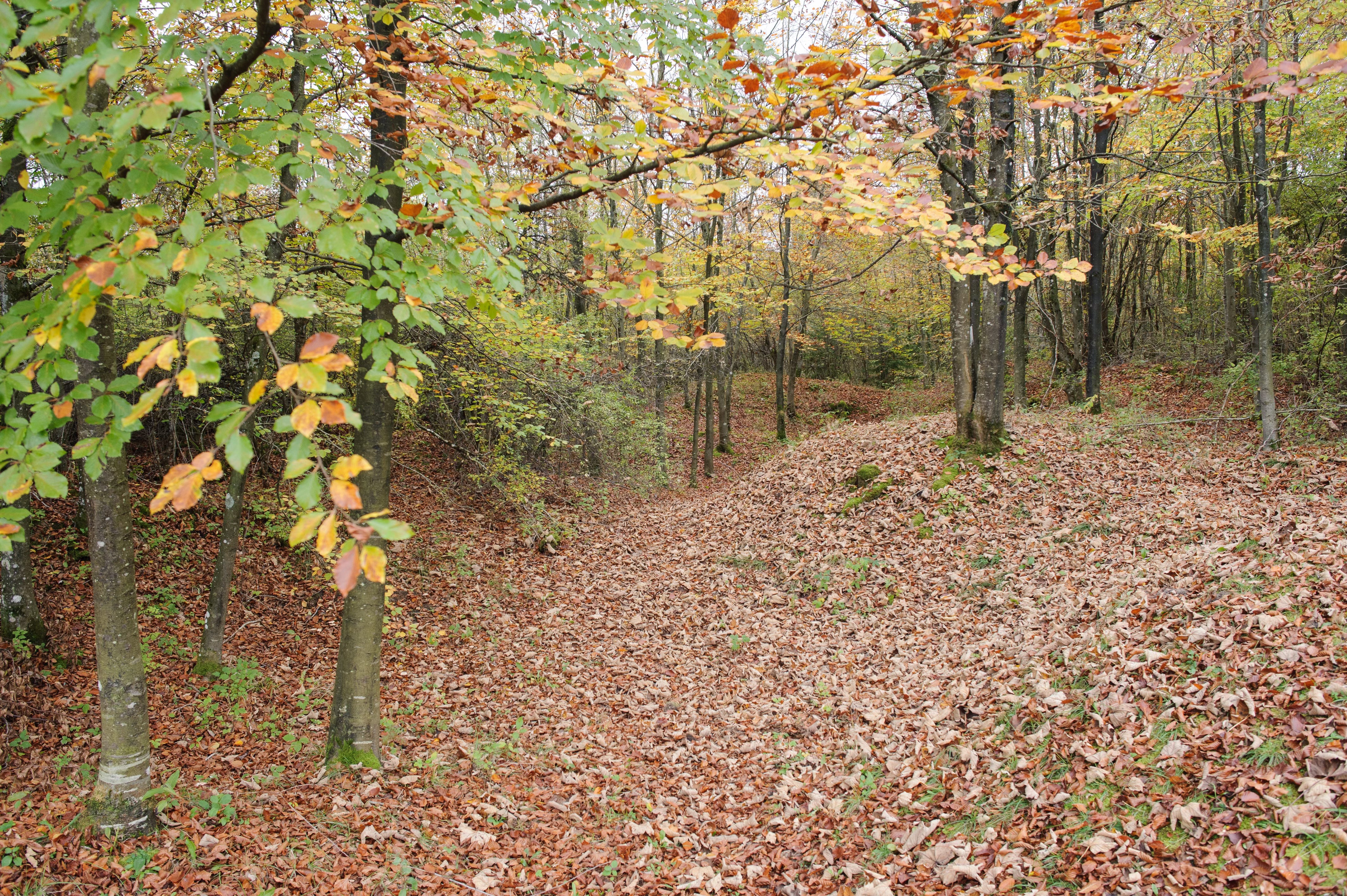
A century has passed; the hillsides over which Tillich and Teilhard laboured at their gruesome work are quiet now – except, that is, on Mondays and Tuesdays when the army use the area immediately to the north of Fort Douaumont as a firing range, offering a faint echo of former times. The woods have closed over the trenches and shell holes, and slowly, silently blanketed the ground with leaves, each one having been deliberately cut off by its tree as it prepares itself for winter. Thousands and thousands of leaves, filling the trenches where men too were cut off and fell, hoping it might be for a greater good.
They found the courage to fight, and those who survived the Great War had their lives changed by it. In spite of all that they wrote of their experiences, we can never fully enter into what it was like to survive in those trenches and shell holes, to wait for the noise to stop, the ground to heave and the sky to be obliterated with the showering mud, or to look along the trench and realise that the man with whom you have shared its privations is no longer there.
The Great War was a moment of change, a fulcrum upon which were balanced so many questions and choices in the way we think about life, religion and the future. It set an agenda through which we have yet to work our way. It threw up questions with which we still wrestle. In particular, it threw into question the meaning of ‘God’ and the relevance of religion. We learn from it what we may.
Thanks for reading!
[For more information about this book and my other publications, along with free notes for students and articles on a range of topics, visit: essexthinker.com, or go direct to the Through Mud and Barbed Wire page.]