Symbols and Creativity
An extract from 'Home: a philosophy of personal space'

Symbols of the personal
Objects become symbolic when they point beyond themselves, reminding us of particular people, values, ideas, places or events. Hence, when we look round a room that we have made our own, we have the sense of who we are and where we have come from, because we can take a mental check on the symbols within our field of vision.
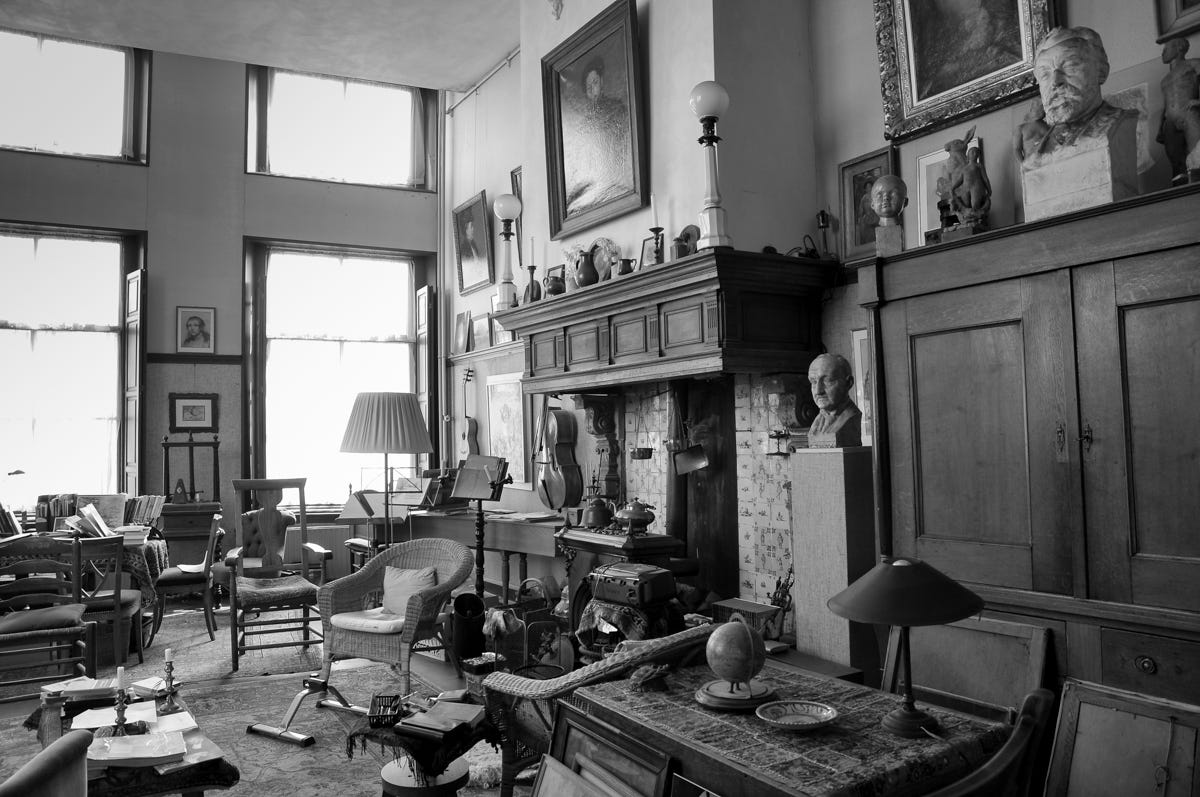
This room contains and speaks of a unique human life.
Devoid of personal symbols, a hotel room may be luxurious, but it cannot be a home. Yet in each of the identical flats in a vast, impersonal block, people may create a sense of home by filling it with things that have special meaning for them. Whether it is in a shed, a loved patch of garden, or the corner of a room, people can surround themselves with symbols that reinforce their sense of self.
I used to work in a hospital, and found that people’s lives were often set out on the lockers by their bedside. Photos of family and friends, gifts, cards, books, fruit; each item, small in itself, served as a symbol for a whole slice of life outside the world of the hospital. Some lockers and tables were utterly cluttered; some almost bare. You can learn a lot from a locker.
But this personalising process may go into reverse. We destroy the personal nature of space whenever we regard it as a commodity. We may be tempted to buy a particular house or flat, not because it has personal significance for us, or has been the focus of our family, but because it promises to offer a certain status and style of living, or to prove a good medium-term investment. We buy personal space on an impersonal prospectus; only after we have bought it do we engage with the optional task of turning a house into a home. Equally, a home may be dismantled, if treated impersonally.
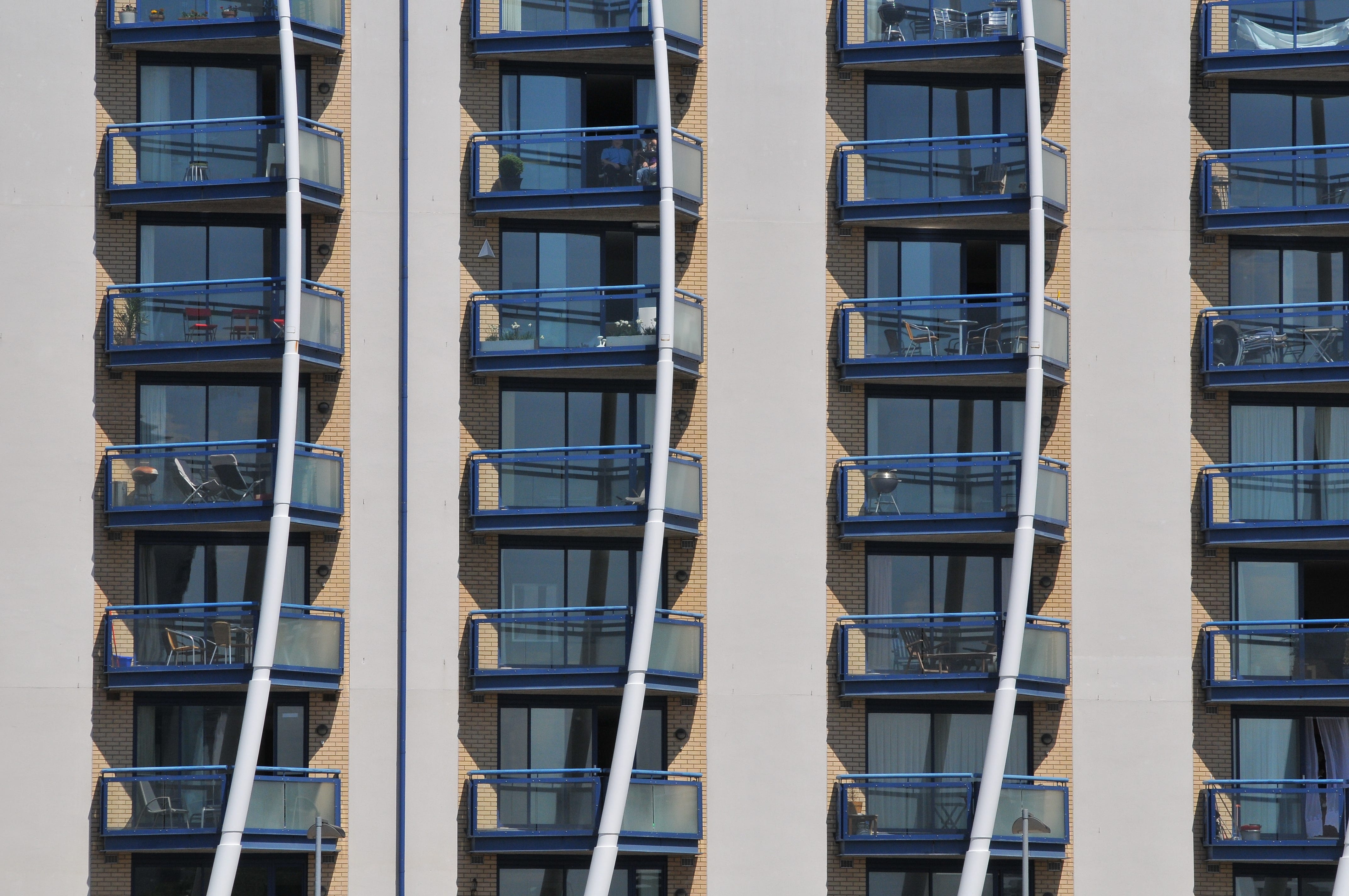
Can each of these flats be personalised to become a home?
One of the saddest things about clearing out the possessions of someone who has died, is disposing of their personal stuff. The long-treasured vase is deemed worthless, and goes to a charity shop, just in case someone can be found to give it a home. On the other hand, a grandparent’s retirement watch, used every day and a constant reminder of a lifetime in the same company, may be worth sending to auction, where it will go to the highest bidder, probably a dealer. Its price will be established, its previous value completely forgotten.
The symbols of our personal space come and go. Some items are cherished and take on a value and meaning far in excess of their monetary worth, while others are no longer wanted and can therefore be reduced to their cash value.
Creativity
Creativity may blossom as a result of achieving a sense of home, or finding inspiration within one’s personal space. Friedrich Nietzsche, for example, came to see the village of Sils-Maria, high in the Alps, as his intellectual and spiritual home. He needed height. He needed the thin atmosphere, clean air and the sense that he was in a dangerous zone where eagles swoop and get their superior view of the ground below. While there, he walked – as have many philosophers – in order to think. Thinking can therefore require both a place and movement. Even pacing up and down can free up blocked thought. We need to be free, to move, to climb, to attain some sort of view over the landscape. We may need space in order to allow our creativity to flourish.

Would you settle for a hut in the mountains as your source of inspiration?
Simplicity and remoteness can also release creativity. Henry David Thoreau’s musings on the simple life, gathered in his Walden; or, Life in the Woods describe the time he spent living a life of self-sufficiency beside Walden Pond, in Concord, Massachusetts, from 1845–7. His cultivation of solitude was a deliberate attempt to see if he could lead a satisfying and fulfilling life separated from other people. He created his own personal space, clearly happy to feel himself at one with the natural world around him.
The philosophy that underpinned his experiment, which he shared with his friend Ralph Waldo Emerson, is termed ‘Transcendentalism’. It used people’s intuition about what was right for them, to explore how society might change in order to promote the development of each individual, reckoning that people were actually aware of themselves and their world in a way that transcended their ordinary day-to-day experience, and that they were at their best when independent and self-reliant. It assumed a fundamental goodness, both in people and in nature – a goodness that was restricted by conforming to the norms of social life, but released by independent living. It had practical as well as intellectual implications that, for Thoreau, involved building his own log cabin by the lake and living the simple life. It was, as much as anything, an exploration of the way in which personal space can be cultivated.
His most-quoted comment, from early in the book, is that ‘the mass of men live lives of quiet desperation’ – contrasting the constant pursuit of status and money, with his quest for simplicity. He contrasts the cabin he constructed with most dwellings:
Most men appear never to have considered what a house is, and are actually though needlessly poor all their lives because they think that they must have such a one as their neighbors have.
Although published in the 1850s, I doubt he would have changed his views if he could have seen the rows of new executive homes springing up to meet the aspirations of the newly wealthy of the twenty-first century, nor consider the way in which property is regarded as a form of investment. We could well argue that, in the quest for an ever-better house, many people suffer lives of quiet mortgage desperation. Thoreau points to the simple fact that housing can become a means of self-identity, but, surely, to want a place ‘such as their neighbors have’ is also a way of gaining identity. In societies where class distinctions still matter, it is possible to buy a property that suggests we belong to one class, while displaying the telltale signs that suggest we actually come from another. There are some social circles, into which one cannot ‘buy’ a place, although in a society dominated by the power of money, their numbers are shrinking fast. What appears to be the quest for a nicer home, may actually be little more than the purchase of a stepping stone by an upwardly-mobile itinerant.
Thoreau contrasts his house with one that is constructed for the purely utilitarian purpose of offering shelter, and yet such a view would seem rather indulgent; after all, it is one thing to deliberately choose simplicity of housing for a limited period of time, quite another to have such simplicity imposed by poverty. But one feature of his housing reflects all that this book went on to argue: that he deliberately chose where he would live and for what purpose. His was not an accidental house, or one pressed upon him by the demands of his social position. This was exactly what he wanted, and it therefore reflected who he was. He chose a ‘space’ and made of it a ‘place’, and that sense of ownership allowed him the leisure to expand on his philosophy of simplicity and pragmatism.
But Thoreau was certainly not the first to seek a place away from the clutter of life. In the early centuries of Christianity, monastic seclusion in the desert was seen as an ideal place for spiritual insight. And this persists in the benefits offered by de-cluttering one’s personal space, or by clarifying the mind through meditation or going on a retreat, whether religious or secular.
Some lucky creators can work whatever their circumstances, but others require the personal workspace to be just right. For writers, it may be the type of pen, or colour of paper, or choice of word-processor or font. For some it’s a matter of the right time of day or night, or the need for seclusion, even if just a room of one’s own. The concepts of personal space and of home therefore apply to particular activities as well as life in general. Get the personal space right, and the juices can flow.
The joined-up world
Creativity, whether of the artistic kind or simply getting on with everyday activities, engages with the world in a way that is quite different from scientific observation. Nature is an interconnected, ever-changing web of events; but, seen through the eyes of science and reason, we divide it up into discrete objects and explore the relationship between them. We speak of one thing or event being ‘caused’ by another, and thereby consider it explained. But in reality, all such causality needs to be qualified, for every cause has its own causes, and those spread outwards from any single event until they embrace the whole universe. Discrete entities and exclusive causes are features of the way our minds work, not of how the world is. Causes appear when we extract a limited number of events, and calculate which follow from which on a regular basis. Causality, as David Hume pointed out, is a habit of mind, but it has become deeply embedded in our consciousness and thus a necessary feature of all experience, as Immanuel Kant argued.
Stand back from that analysis, however, and our experience becomes more complicated. I may start by thinking of myself as a separate object, relating to a world that is outside me and about which I am informed by my senses. But I cannot deny that I am also part of that world – I act; I change or avoid things; I eat, breed, survive and grow; eventually, if I survive that long, I will become old and die. But my experience of being is not the same as an objective, analytic description of what it is to be. In that way of thinking, I become no more than the firing of neurones and the processing of food and oxygen, a complex machine, set within a larger machine. The ‘I’ of my engaged experience is nowhere to be found.
We only reinstate the ‘I’ of self-awareness once we choose to interpret the world in personal terms and give it value. Self and world form a necessary pair. Once they separate – once I stop feeling part of the world but only an observer of the world – I am lost in space, confronted by an impersonal and meaningless universe; I no longer have a place where I belong.
But that’s not how life is, or needs to be. Once we acknowledge and take responsibility for our personal space, we engage with life more directly and creatively. But, of course, life has a social dimension that cannot be ignored. Our sense of home has profound political consequences, both good and bad, to which we need to turn.
[This is an extract from Home: a philosophy of personal space. For more information about this and other publications, along with free notes and articles, see: essexthinker.com .]